
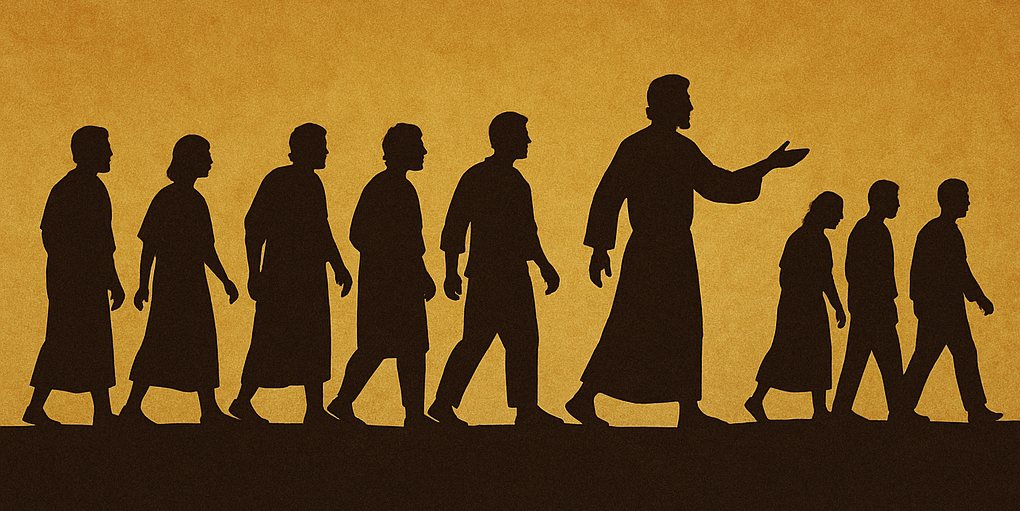
Originally shared at Gospel Light Church on October 12, 2025.
About This Message
When I first started preparing for this message, I wasn’t sure what direction God would lead me. My first thought was to share a little bit about the disciples and who they were before they followed Jesus, but as I studied and prayed, the Lord began steering my heart in a slightly different direction.
Over time, it became clear that God wanted me to talk about who He chooses to use.
Scripture shows again and again that God doesn’t look for the polished, the powerful, or the perfect; He calls the humble, the broken, and the willing.
That truth resonated deeply with me. Like many of the people in the Bible, I’ve often felt unworthy or uncertain why God would use me at all. But 1 Corinthians 1 reminded me that this is exactly God’s way: He takes what the world calls “nothing” and uses it to show His strength.
This message is less about me and more about the grace of a God who calls the unqualified, equips the willing, and turns weakness into strength.
God Chooses the Unlikely
The Apostle Paul explains this beautifully in 1 Corinthians 1:26–29 (KJV):
“For ye see your calling, brethren, how that not many wise men after the flesh, not many mighty, not many noble, are called: But God hath chosen the foolish things of the world to confound the wise; and God hath chosen the weak things of the world to confound the things which are mighty; And base things of the world, and things which are despised, hath God chosen, yea, and things which are not, to bring to nought things that are:
That no flesh should glory in his presence.”
Before we dive into these verses, let’s take a moment to understand what this book of the Bible is so we can gain a bit of context. 1 Corinthians is a letter written by Paul, under the inspiration of the Holy Spirit, to the Church in Corinth. Corinth was a wealthy, proud, and immoral city, not unlike a modern-day New York or Las Vegas. The believers there struggled with pride and division, trying to mix their faith with the world’s values. Paul wrote this letter to the church to reminded them that God doesn’t build His kingdom through status, intellect, or influence. He builds it through faithfulness and humility.
If you’ve ever felt disqualified, this passage is for you. You are exactly the kind of person God loves to use.
God’s Way Is Not the World’s Way
So, what do these verses mean? Let’s go through them one-by-one and break them verses down using language that’s more similar to our manner of speaking today so that we can better understand what God was saying to the Church through Paul.
In 26 the bible says: “26For ye see your calling, brethren, how that not many wise men after the flesh, not many mighty, not many noble, are called:”
· What he’s saying to the church is: Look around: most of the people that were called to serve weren’t highly educated, they weren’t powerful, they weren’t born into rich or influential families
· God didn’t pick the best and brightest, the rich and famous, or the most respected people in society to build His kingdom.
· Who are the strongest in faith? Would you bet that it’s the person with the highest education? How about the person the biggest paycheck? Or is it the one who prays faithfully, serves, and puts their trust in God?
In 27 the bible says “27But God hath chosen the foolish things of the world to confound the wise; and God hath chosen the weak things of the world to confound the things which are mighty;”
· This verse was the clearest to me when I read it, but let’s simplify it a bit anyway
· God flips the script. He chooses people that the world would call “foolish” or “weak” to put the “smart” and “strong” in their place.
· God loves underdogs. He uses the ones nobody expected. This shows the power of God. It shows those that are “smart” or “powerful” in the world’s eyes that God is the one holding the power so no one can boast in their own strength.
· I’m reminded of David when he fought Goliath. The weak became the strong with God.
In 28 the bible says: “28And base things of the world, and things which are despised, hath God chosen, yea, and things which are not, to bring to nought things that are:”
· This one took me a bit of effort to unpack and understand, but what Paul is saying in this letter is:
· My paraphrase: God has chosen what is basic and despised in the world. Yes, and things that are nothing to the world. He chose those things to knock down those things that are highly regarded to the world
· God doesn’t just use the lowly, He chooses them. He uses nobodies to turn worldly “somebodies” to nothing
· The world says you need money, popularity, and influence. God says, “Give me someone humble and obedient, and watch what I can do.”
In 29 the Bible says: “That no flesh should glory in his presence.”
· The whole point is this: no one gets to brag. We can’t say, “God picked me because I’m awesome.” Nope, that’s not how it works.
· It’s not about what you’ve done, it’s about what God can do through you. That way, when something amazing happens, God gets the credit.
· If you ever think God can’t use you, remember this: your weakness is what qualifies you. Not your resume. Not your reputation. He picks the humble, the overlooked, and the broken, because He’s the one who brings the transformation.
· In summary, this verse tells us that you don’t have to be high and mighty for God to use you. In fact, God chose those things that are low, foolish, weak, or nothing in the eyes of the world to do His work. And through this His strength is shown, not ours.
Paul is saying God chooses the “foolish” and “weak” things to shame the “wise” and “mighty.” In other words, God flips the world’s logic upside down. The world says: Be strong, be impressive, be in control. God says: Be humble, be faithful, and trust Me. No one can boast in their own strength because the glory always belongs to Him. Let’s look at three examples of how God used ordinary, imperfect people to do extraordinary things.
1. Peter – The Impulsive Fisherman
Peter was a fisherman, hardworking, outspoken, and far from refined. Yet he’s one of the clearest pictures of God transforming weakness into strength.
- He walked on water but sank when fear took over (Matthew 14:28-30).
- He tried to correct Jesus about His own death and was rebuked:
“Get thee behind me, Satan.” (Matthew 16:23)
- He blurted out ideas during the Transfiguration until God interrupted him from a cloud, saying,
“This is my beloved Son… hear ye him.” (Matthew 17:4-5)
- He cut off a man’s ear in panic when Jesus was arrested (John 18:10).
- He vowed loyalty but denied Jesus three times (Matthew 26:70-74).
After Jesus’ resurrection, Peter thought he was disqualified and said, “I’m going fishing.” (John 21:3) But Jesus met him on that same shore and restored him:
“Do you love Me? … Feed My sheep.” (John 21:15-17)
This happened 3 times in a row.
Jesus gave Peter three chances to affirm the love he had once denied. From that moment forward, Peter’s life changed.
God’s work through Peter:
- Preached at Pentecost where 3,000 were saved (Acts 2).
- Opened the Gospel to Jews, Samaritans, and Gentiles (Acts 2, 8, 10).
- Wrote 1 & 2 Peter, letters that still strengthen believers today.
Peter was impulsive and flawed, but he was also willing and teachable.
If God can use a fisherman like Peter, He can use anyone willing to follow.
2. Matthew – The Hated Tax Collector
Before following Jesus, Matthew was a tax collector (Matthew 9:9). To first-century Jews, that meant one thing: traitor. He collected money for Rome, the enemy occupier, and padded his pockets by overcharging his own people.
He was seen as greedy, corrupt, and spiritually unclean.
And yet, Jesus looked him in the eye and said, “Follow Me.”
Matthew didn’t hesitate. He stood up, left his booth, and followed.
Later, Matthew threw a banquet for Jesus, inviting many tax collectors and “sinners.” The Pharisees were disgusted:
“Why does your teacher eat with tax collectors and sinners?” (Matthew 9:11)
Jesus answered,
“They that be whole need not a physician, but they that are sick…
I am not come to call the righteous, but sinners to repentance.” (Matthew 9:12-13)
That single statement reveals the heart of the Gospel:
Jesus meets people where they are, not where others think they should be.
God’s work through Matthew:
- He became one of the twelve apostles.
- He wrote the Gospel of Matthew, the longest and most teaching-filled Gospel in Scripture.
- He reached others like himself, inviting fellow tax collectors and sinners to meet Jesus.
Matthew’s life reminds us that no reputation is beyond God’s redemption.
3. Thomas – The Honest Doubter
Thomas is often remembered as “Doubting Thomas,” but his story is really about a loyal man who wanted to believe.
When Jesus planned to return to Judea, a dangerous move, Thomas said,
“Let us also go, that we may die with him.” (John 11:16)
He was loyal, even if pessimistic.
Later, at the Last Supper, Thomas asked an honest question:
“Lord, we know not whither thou goest; and how can we know the way?” (John 14:5)
That question prompted Jesus’ famous response:
“I am the way, the truth, and the life.” (John 14:6)
After the resurrection, Thomas doubted the others’ report:
“Except I shall see in his hands the print of the nails, and put my hand into his side, I will not believe.” (John 20:25)
When Jesus appeared again, He didn’t rebuke Thomas. Instead, He said,
“Reach hither thy finger, and behold my hands… and be not faithless, but believing.” (John 20:27)
Thomas immediately declared,
“My Lord and my God!” (John 20:28)
Jesus replied,
“Thomas, because thou hast seen me, thou hast believed: blessed are they that have not seen, and yet have believed.” (John 20:29)
Thomas’ doubt turned into one of the strongest confessions of faith in Scripture, and a word of encouragement for all who believe without seeing.
What This Means for Us
Peter, Matthew, and Thomas were three very different men with three very different flaws, but God used them all.
- Peter was impulsive.
- Matthew was corrupt.
- Thomas was skeptical.
Each met Jesus, and each was transformed.
God isn’t looking for perfection, He’s looking for willingness.
If you’ve failed, God can still use you.
If you feel ordinary, that’s who He delights in using.
If you wrestle with doubt or regret, He meets you right there.
Jesus gave every believer the same calling in Matthew 28:19–20:
“Go ye therefore, and teach all nations, baptizing them in the name of the Father, and of the Son, and of the Holy Ghost:
Teaching them to observe all things whatsoever I have commanded you: and, lo, I am with you always, even unto the end of the world.”
That command wasn’t only for pastors or missionaries, it was for all of us.
Fishermen. Teachers. Parents. Mechanics. Teenagers. Retirees.
Ordinary people called to share an extraordinary message.
God Is Still Working
The same Jesus who said “Follow Me” to Peter, Matthew, and Thomas still calls us today.
Don’t disqualify yourself, He already qualified you when He saved you.
Paul wrote in Philippians 1:6 (KJV):
“Being confident of this very thing, that he which hath begun a good work in you will perform it until the day of Jesus Christ.”
God began a good work in you when you were saved, and He’s not done yet.
You don’t have to be perfect,you just have to follow Him.
If You’d Like to Learn More
If this message encouraged you, or if you’d like to know more about following Jesus, we’d love to hear from you.
You can visit Gospel Light Church in person or reach out online for prayer, questions, or to learn more about our community of believers.
“Simply put, God is still working on you. Follow Him.”