
Waiting is one of the hardest spiritual disciplines—perhaps because it rarely feels like a discipline at all. It feels passive. Empty. Unproductive. We are taught to pray, to ask, to seek. But when the answer does not come quickly—or comes differently than expected—we struggle to understand what God is doing in the silence.
Scripture, however, tells a different story. Over and over, God works through delay. Promises unfold slowly. Requests are answered in ways that only make sense decades—or centuries—later. And sometimes, the answer is not denied at all. It is simply postponed until the moment when God’s greater purpose can be revealed.
Few biblical lives illustrate this more powerfully than the life of Moses.
The story begins where all human longing begins: the Garden of Eden.
Genesis describes a world where God walked with humanity. After Adam and Eve sinned, Scripture records that they “heard the voice of the LORD God walking in the garden in the cool of the day” (Genesis 3:8). While the text does not explicitly say “face to face,” it portrays something intimate and unbroken—God and man sharing space, presence, and fellowship.
That closeness did not survive the fall.
Adam and Eve were driven out, and cherubim were placed at the east of the garden with a flaming sword to guard the way back (Genesis 3:24). Humanity lost more than a location. We lost access—direct, unfiltered communion with God.
Centuries later, Moses emerges as a singular figure in Israel’s history. Scripture says something about him that is said of no one else:
“And the LORD spake unto Moses face to face, as a man speaketh unto his friend.” (Exodus 33:11)
Yet even Moses encountered limits.
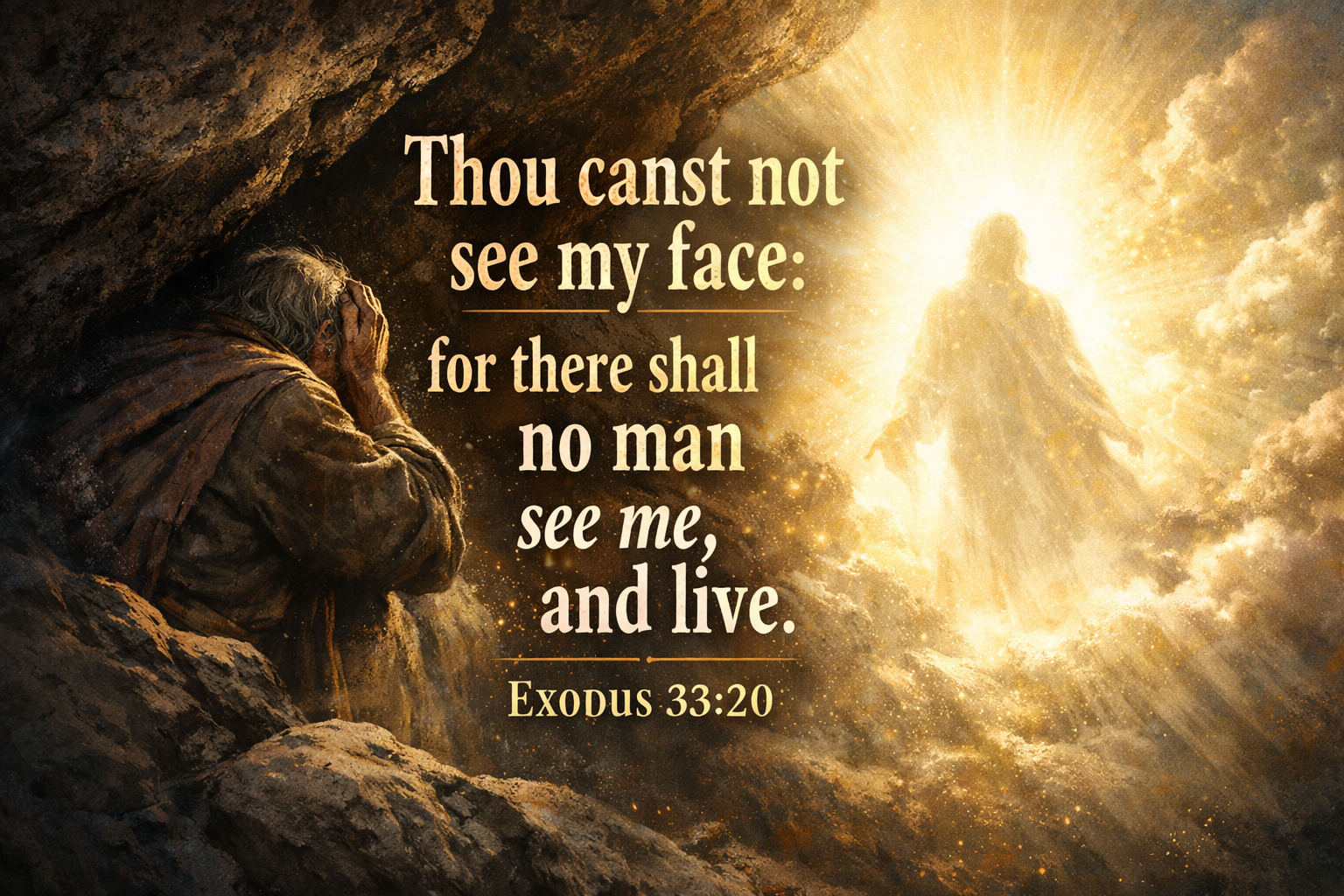
When he asked, “I beseech thee, shew me thy glory” (Exodus 33:18), God responded:
“Thou canst not see my face: for there shall no man see me, and live.” (Exodus 33:20)
Moses was close—but not all the way.
God placed him in the cleft of the rock, covered him with His hand, and allowed him only a partial glimpse as His glory passed by (Exodus 33:22–23). Instead of showing His face, God declared His name and character (Exodus 34:6–7).
Moses asked to see glory. God allowed him to hear it.
Scripture later makes clear that Moses was denied two things in his lifetime: seeing God’s face and entering the Promised Land.
Because Moses struck the rock instead of speaking to it, God said:
“Because ye believed me not… therefore ye shall not bring this congregation into the land which I have given them.” (Numbers 20:12)
At the end of his life, Moses stood on Mount Nebo and looked across the land—but never entered it (Deuteronomy 34:4).
But God was not finished.
Before Moses died, God promised:
“The LORD thy God will raise up unto thee a Prophet… like unto me.” (Deuteronomy 18:15)
The New Testament identifies this Prophet as Jesus (Acts 3:22; Acts 7:37).
When John opens his Gospel, he declares:
“And the Word was made flesh, and dwelt among us, and we beheld his glory.” (John 1:14)
“No man hath seen God at any time; the only begotten Son… he hath declared him.” (John 1:18)
What Moses longed to see was not denied forever. It was delayed.
Jesus is called “the image of the invisible God” (Colossians 1:15) and “the express image of his person” (Hebrews 1:3). It is a theological inference—but a compelling one—that God forbade images because He would one day provide the true Image Himself.
Then comes the Transfiguration.
“And his face did shine as the sun.” (Matthew 17:2)
“And there appeared unto them Moses and Elias talking with him.” (Matthew 17:3)
Scripture does not name the mountain, but it was within the land Moses was once forbidden to enter.
There, Moses finally stood in the Promised Land.
There, Moses finally saw the glory of God—not hidden, not partial, but shining in the face of Jesus Christ.
Scripture does not explicitly say this moment fulfills Moses’ earlier exclusions. That conclusion is theological, not textual. But it aligns deeply with how God works.
God’s answers are not always immediate. But they are always faithful.
What feels like silence may be preparation.
What feels like delay may be design.
What feels unfinished may simply be waiting for the right moment.
God keeps His promises.
Sometimes, He just keeps them longer than we expect.